-
Classification systems for CP
The most important ones at a glance
- Bilateral, leg-predominantBoth legs affected
- HemiparesisOne side of the body affected
- Unilateral, leg-predominantOne leg affected
- Whole body affectedWhole body affected
- ParentsParents
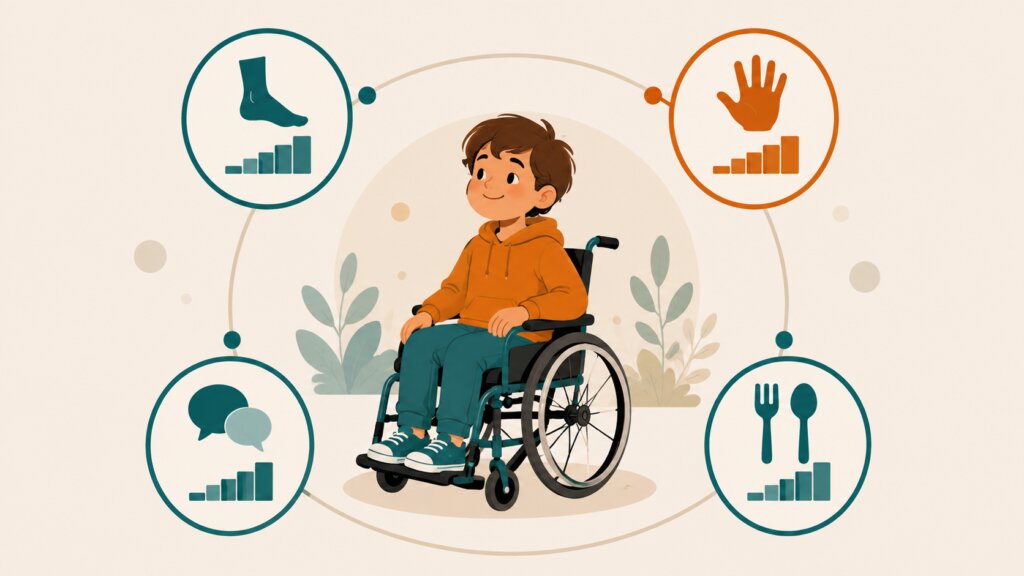
After a cerebral palsy diagnosis, you quickly come across abbreviations like GMFCS, MACS, CFCS or EDACS, often without much explanation. This Power-up introduces you to the five common classification systems: GMFCS for mobility, MACS for hand use, CFCS for communication, EDACS for eating and drinking, and VFCS for vision. Each system divides everyday abilities into five levels, and the level can differ from one area to another. Using case examples, you learn to classify the systems yourself, and discover how they help set realistic goals and speak a common language with professionals.
What is a classification system?
A classification system describes the everyday life of a person with cerebral palsy (CP).
It shows: What goes well?
Where is help needed?
It does not describe CP.There are 5 systems
Each system looks at one area:
- The GMFCS looks at movement.
- The MACS looks at the hands.
- The CFCS looks at communication: Does the person understand others? Do others understand the person?
- The EDACS looks at eating and drinking.
- The VFCS looks at seeing.
Each system has 5 levels
All systems have 5 levels.
Level 1 means: little help needed.
Level 5 means: a lot of help needed.Each area has its own level
A person with CP has a level for each area.
The levels can be different.
An example: Lina.
Lina needs a lot of help with walking.
Lina needs almost no help with talking.
Both are true at the same time.Who decides the level?
There is no test for the level.
Experts ask you questions.
You know everyday life best.
That is why your answers are important.Everyone talks about the same thing
Doctors use these systems.
The therapy team uses them too.
And the school.
So everyone talks about the same thing.
